Observation
Something any teammate could verify by looking. "Four portraits. Each has a brass plate with a year."
A room tells you its puzzles through objects long before it tells you its plot. Learn to inventory first and theorise second.
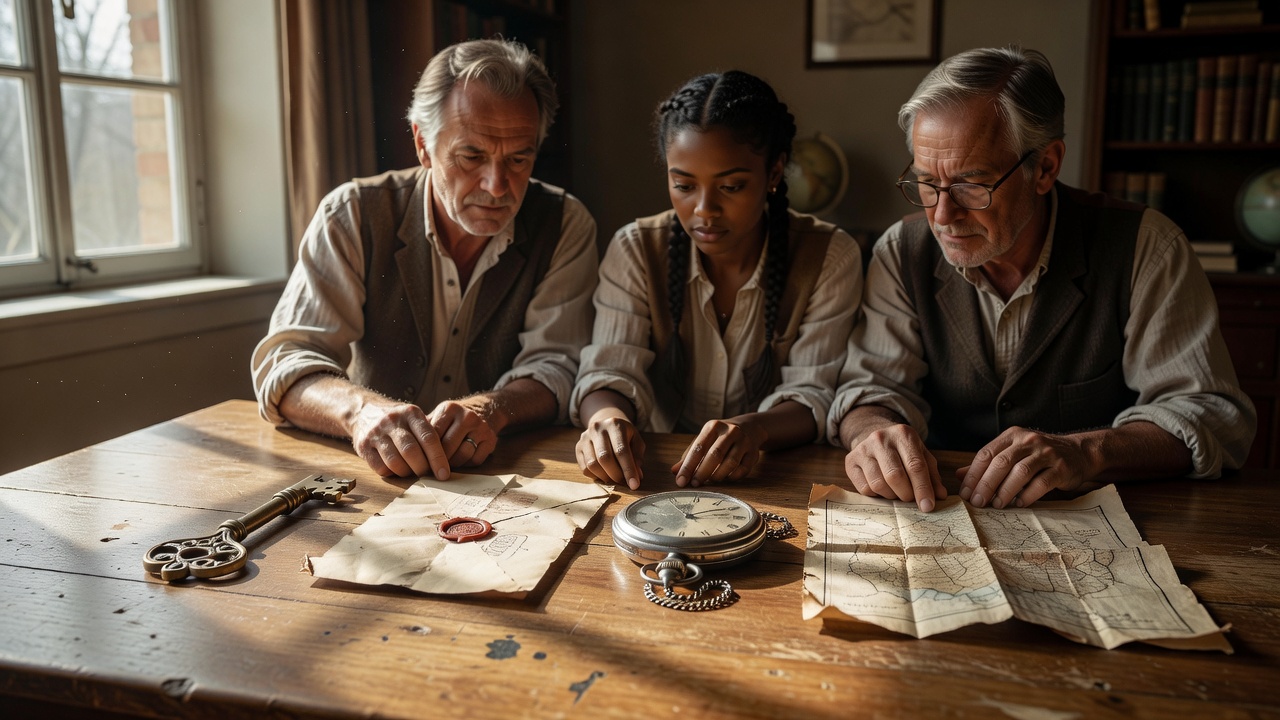
In Arthur Conan Doyle's "A Scandal in Bohemia" (1891), Sherlock Holmes asks Watson how many steps lead up to their rooms at 221B Baker Street. Watson has climbed them hundreds of times and has no idea. Holmes knows: seventeen. "You see, but you do not observe," he says. That line is the most useful sentence ever written for escape-room players.
When a door closes behind your team, the room is not yet a story. It is a collection of objects, surfaces and quantities. The plot — the missing professor, the stolen painting, the submarine running out of air — gives atmosphere. The props give answers. Newcomers often read the intro letter, grab the most dramatic object and start guessing. Experienced teams spend the first few minutes building an honest inventory.
Something any teammate could verify by looking. "Four portraits. Each has a brass plate with a year."
A possible meaning. "The years might give a four-digit code." Useful, but still a guess.
Confirmation from outside the guess: a matching lock, a second clue that agrees, a mechanism responding.
Random searching finds the obvious items quickly and the subtle ones never. A simple pattern borrowed from crime-scene practice — divide the space, assign it, sweep it — works remarkably well in a ten-square-metre room.
One warning that every venue will repeat: you never need force. If something needs prying, unscrewing or climbing, it is almost certainly not part of the game. Good rooms mark out-of-bounds items with a sticker or symbol; respect it, and save yourself — and the staff — a broken prop.
Designers have only a few ways to embed a code in a physical object, and once you know them you will spot candidates instantly:
When a lock has a particular shape — three digits, four letters, five directions — list every observation that could fill that shape. Then look for the clue that tells you which one, and in which order.

Players often suspect every object is a trick. In practice, most well-regarded venues avoid deliberate red herrings, because they waste time without adding any satisfaction. What you will find instead is noise: furniture, books and pictures that set the scene. The difference matters. Noise should look ordinary and consistent; a clue usually breaks a pattern, repeats a symbol or fits a lock shape.
Detective fiction faced the same issue long before escape rooms existed. In 1929 the writer and priest Ronald Knox published his "Ten Commandments" of detective fiction, a light-hearted code of fair play adopted in spirit by the Detection Club. One rule says the detective must not hide any clue from the reader. Good rooms follow the same principle: if the answer depends on it, you can find it.
Escape rooms as we know them grew out of that tradition and out of point-and-click games such as Toshimitsu Takagi's "Crimson Room" (2004). Takao Kato's company SCRAP staged its first live "Real Escape Game" in Kyoto in 2007, and the format spread quickly through Budapest, London and beyond. Across all of them, the strongest designs reward observation over guesswork.
A teammate shouts out four statements during a game. Label each as observation, interpretation or proof.
Ask of each statement: could someone verify this just by looking, without guessing?
Only one statement describes the room responding.
1 and 3 are observations. 2 is an interpretation. 4 is proof.
Next casefile: once you have observed a set of strange marks, you need to turn them into a key. Continue to the Codebook, or jump to Team Logic to share your observations efficiently.